Blog
The Silent Return of Economic Nationalism and what it means for brands
The New Risk Brands Underestimate: Access, Not Awareness

Ranjan Das
· Posted: 2026-01-12
Posted: 2026-01-12
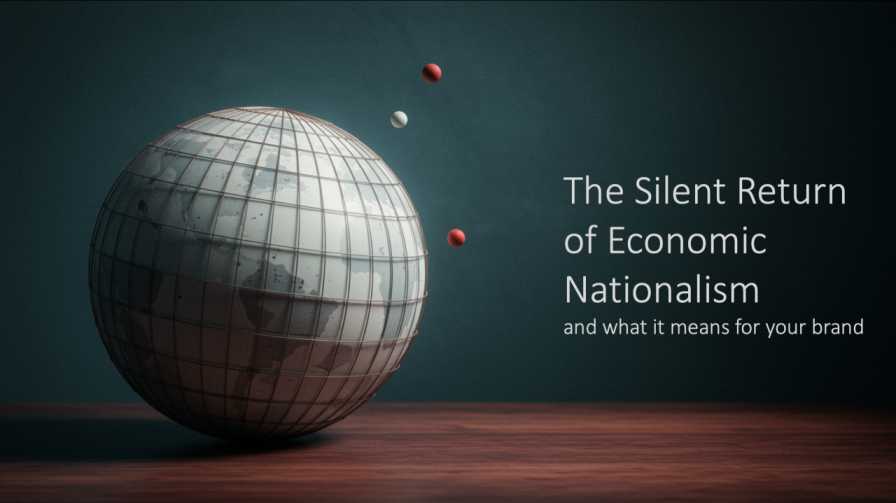
For a long time, globalisation felt like a settled fact. Supply chains chased efficiency. Brand playbooks travelled easily across borders. Market entry was largely a commercial question—product, price, distribution, and communication.
That certainty is quietly fading.
What’s returning isn’t old-school protectionism everywhere. It’s something subtler and more embedded. Economic nationalism is now woven into industrial policy, climate policy, security concerns, and procurement rules. Often it isn’t announced loudly—it’s designed quietly into the system.
And brands feel it long before economists give it a name.
What economic nationalism looks like today
It rarely shows up as a blunt ban or tariff anymore. Instead, it appears through softer, more complex signals.
- Governments are using incentives to pull manufacturing and capabilities closer to home.
- “Buy local” is being written into policy language rather than advertising slogans.
- Climate compliance is becoming a new filter for market access.
- Standards, disclosures, and paperwork are quietly replacing borders.
In simple terms, access is no longer just about demand. It’s also about permission.
Why brands notice it before anyone else does
This shift doesn’t announce itself in headlines. It shows up in everyday decisions.
- A supplier suddenly becomes non-viable because compliance costs change.
- A product loses competitiveness without its raw material cost changing.
- Market entry plans now require regulatory and political literacy, not just consumer insight.
- Brand narratives feel riskier as country-of-origin sentiment becomes volatile.
This is why industrial policy has returned to boardroom conversations—and why market entry has become less predictable than it once was.
The new brand battlegrounds
1) Positioning: “global” doesn’t always land the same way anymore
In some markets, global still signals scale and quality. In others, it can feel distant, extractive, or politically loaded. Brands now need to stay consistent globally while earning legitimacy locally.
Time to ask yourself, where do you still see “global” working as a strength, and where has it quietly become a weakness?
2) Pricing: invisible costs are becoming very real
Costs aren’t only moving because of materials or labour anymore.
- Compliance adds friction.
- Reporting adds effort.
- Verification adds time.
- Rerouting supply chains adds cost.
Pricing pressure often arrives months before it shows up clearly in financial reports. Have you had to rethink pricing or packaging because of compliance or policy, not competition?
3) Go-to-market: entry is now partly a political skill
Market entry used to be about channels, pricing ladders, and localisation.
Today, it also involves:
- Incentive mapping
- Regulatory narratives
- Local partnership logic
- Supply-chain “friendliness”
Ignoring these doesn’t slow you down—it blocks you. If you entered a new market recently, what surprised you more: customers, competitors, or policy friction?
4) Brand trust: “made in” and “made for” are diverging again
Country-of-origin is returning not just on labels, but in perception. Some brands now need to be “made for here” even if they aren’t “made here.” Marketing increasingly overlaps with legal, sustainability, procurement, and public policy—not because marketing has become political, but because the environment has.
The two mistakes brands are most likely to make now
Mistake one: assuming this is temporary noise that will settle down. The signals suggest otherwise.
Mistake two: responding with surface-level localisation. Local symbols without local value creation don’t build legitimacy.
Real legitimacy comes from:
- Local jobs
- Local suppliers
- Local capability
- Local relevance
A simple boardroom test before entering or scaling a market
Before you move, ask yourself:
- Where is value expected to be created, inside the country or outside it?
- Which policies could quietly change your economics later?
- If rules tighten in 18 months, do you still win?
- What story makes you legitimate here beyond price and promotion?
If these answers feel fuzzy, the risk isn’t marketing failure. It’s an access failure.
A closing thought
This shift isn’t anti-global. It’s pro-reality.
Economic nationalism is returning not as rhetoric, but as design embedded in incentives, standards, and expectations. It will reward brands that can stay globally coherent while building genuine local legitimacy.
The winners won’t be the loudest or the fastest. They’ll be the most adaptable.
Why India changes the equation
For India, this moment carries a particular nuance.
India is not closing itself off, nor is it passively opening its doors. It is selectively shaping where and how value is created—through manufacturing incentives, localisation expectations, digital public infrastructure, and regulatory frameworks that reward long-term commitment over short-term extraction.
For global brands, India is no longer just a high-growth market. It is a test of intent.
Those who treat India purely as a volume opportunity will continue to face friction, sometimes subtle, sometimes overt. Those who invest in local capability, partner ecosystems, and relevance beyond price will find India remarkably open, patient, and scalable.
For Indian brands expanding outward, the lesson is equally important. The same sensitivities India now asserts abroad will increasingly be mirrored elsewhere. Expansion will require not just ambition, but institutional empathy.
In a multi-polar world, India sits not at the margins, but at the negotiating table. Brands that understand this—quietly, respectfully, and early—will be better positioned for the decade ahead.
Key Watchouts for National & MNC Brands Operating in India
1. India is now a policy-shaped market, not just a growth market. Winning in India increasingly depends on how well brands read incentives, compliance norms, localisation expectations, and digital public infrastructure not just on brand strength or marketing spend.
2. Localisation has shifted from communication to capability. Language, imagery, and cultural cues are no longer enough. India rewards brands that build local supply chains, partnerships, talent, and real decision-making authority on the ground.
3. Pricing pressure will emerge quietly through regulation, not competition. Margins may change due to compliance, sourcing rules, reporting requirements, or taxation, often without a visible competitive trigger. Price erosion can arrive silently.
4. Country-of-origin perception is now situational, not fixed “Foreign” is neither an advantage nor a disadvantage by default. Its meaning changes by category, price point, timing, and context. Consumers are far more selective in how they interpret it.
5. India’s digital infrastructure creates opportunity and expectation. DPI enables scale, speed, and reach, but also raises the bar on transparency, responsiveness, and interoperability. Brands that adapt slowly won’t be rejected—but they will face friction.
6. Trade and channel relationships are becoming more formal and compliance-led. Distributor, marketplace, and retail dynamics are tightening. Informal advantages and legacy arrangements are steadily disappearing.
7. ESG and compliance are no longer optional hygiene factors for MNCs; especially, gaps in governance, sustainability, or disclosure may not block entry immediately, but they will slow expansion and invite scrutiny over time.
8. India will test intent before rewarding scale The market still rewards long-term commitment, but it increasingly penalises short-term extraction. Brands are remembered for how they behave, not just how fast they grow.
How People, Customers, and Talent Are Likely to Respond
9. Consumers will reward intent, not just origin. Indian customers are paying attention to why a brand is here. Brands that build locally earn patience; those perceived as extracting value face quiet disengagement rather than public backlash.
10. “Global” no longer excuses poor local understanding Applying global templates without adapting to Indian realities—usage patterns, price sensitivities, service expectations—is increasingly seen as indifference, not efficiency.
11. National brands will be held to higher standards than before As Indian brands scale, consumers expect world-class quality, consistency, and governance. Being “Indian” is no longer a shield for uneven delivery.
12. Trust will move faster than loyalty. Trial will be easy. Loyalty will be conditional. Opportunistic behaviour—sudden price hikes, diluted value, poor service—will be remembered and shared.
13. Value will be judged beyond price alone. Affordability still matters, but reliability, transparency, ethics, and long-term relevance now shape value perception just as strongly.
14. Employees will quietly shape brand reputation. Talent especially younger professionals—will judge brands on empowerment, autonomy, and purpose. Internal sentiment increasingly spills outward.
15. Service experience will define “foreign” versus “local” perception For MNCs, rigid processes reinforce distance. For national brands, responsive service builds confidence that local can be world-class.
16. Customers expect brands to choose India consciously. India is no longer seen as a default market. Consumers and partners sense whether a brand has chosen India strategically—or merely followed the numbers.
17. Silence will be interpreted, not ignored. Brands may stay neutral on global issues, but inconsistency in local behaviour will still be judged. Quiet consistency matters more than loud positioning.
18. Switching costs are now emotional, not technical Digital ease makes switching effortless. What retains customers is trust, familiarity, and emotional comfort—once broken, these are hard to rebuild.
The underlying shift
For MNC brands, the unspoken question is: “Are you here to participate—or merely to profit?”
For national brands, it is: “Now that you’ve scaled, can you be trusted consistently?”
In today’s India, customers rarely protest. They simply move on.
Over to the community: Where are you seeing this play out most clearly in India or elsewhere? And how are you adapting without losing the core of your brand?
I’d genuinely value learning from your experience.
Check Post on LinkedIn via the link below.
https://www.linkedin.com/posts/kumarranjan
Marketing is everything, products are
woven around it.